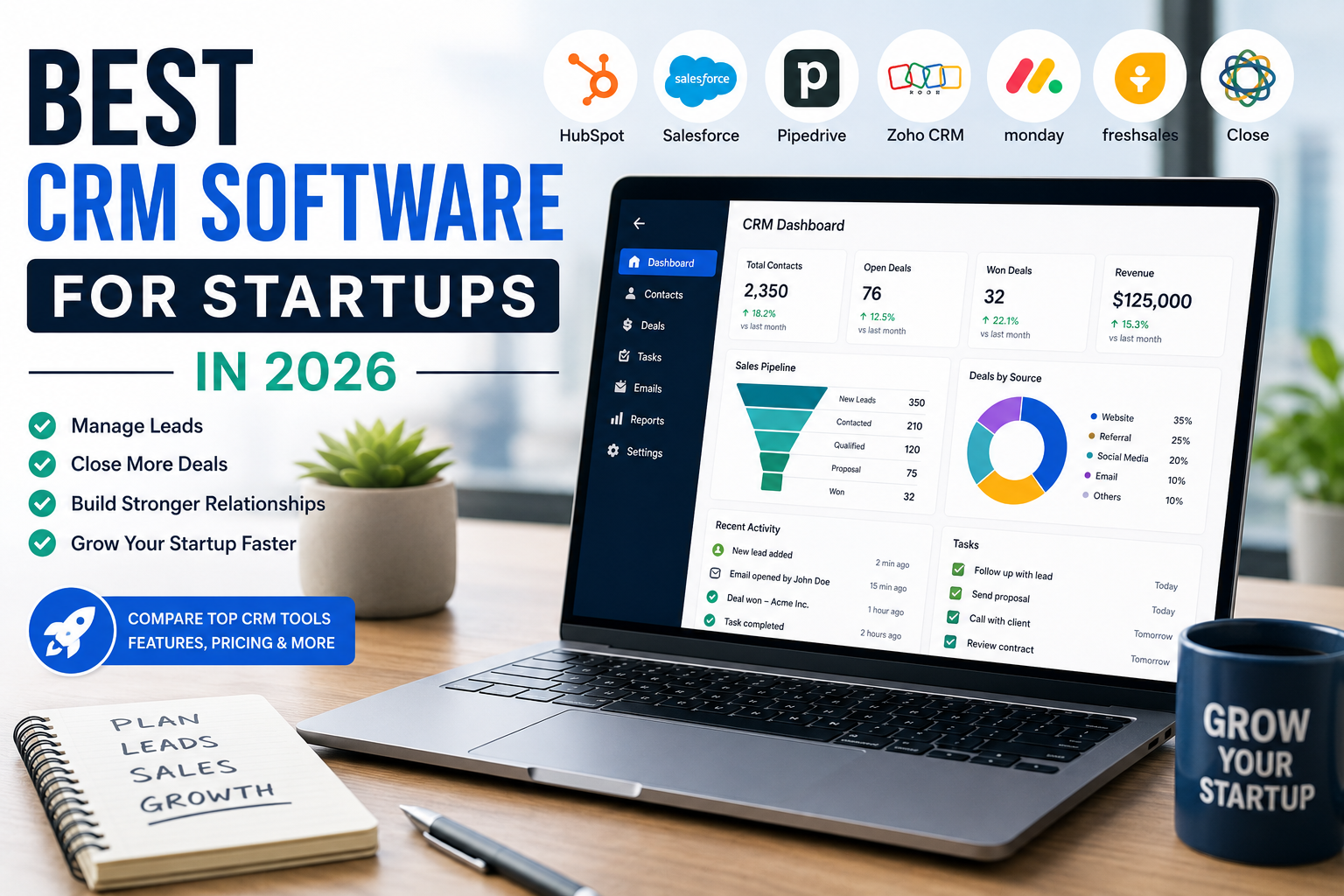
Choosing the right CRM software can make or break a startup. In today’s competitive business world, startups need more than spreadsheets and manual follow-ups to manage leads, customers, and sales pipelines effectively.
The best CRM software helps startups automate sales processes, improve customer relationships, increase conversions, and scale faster without hiring massive teams.
In this guide, we’ll explore the best CRM software for startups in 2026, including pricing, features, pros, cons, and which CRM is best for different business needs.
What Is CRM Software?
CRM stands for Customer Relationship Management.
CRM software helps businesses organize customer data, track sales interactions, automate workflows, and improve communication with leads and existing customers.
For startups, a good CRM can help:
- Manage sales pipelines
- Track leads
- Automate emails
- Improve customer support
- Increase productivity
- Boost revenue growth
Why Startups Need CRM Software
Many startups lose potential customers because they fail to follow up consistently or organize their sales process properly.
CRM software solves these problems by centralizing customer information and automating repetitive tasks.
Key Benefits of CRM for Startups
Better Lead Management
Track every lead from first contact to final sale.
Improved Team Collaboration
Sales and marketing teams stay aligned.
Automation
Reduce manual work using automated workflows.
Better Customer Experience
Respond faster and personalize communication.
Sales Growth
Increase conversion rates through organized pipelines.
1. HubSpot CRM – Best Overall CRM for Startups
Best For:
Startups looking for an all-in-one free CRM
HubSpot CRM remains one of the most popular CRM platforms for startups because of its powerful free plan and scalable features.
It combines sales, marketing, customer support, and automation tools in one dashboard.
Key Features
- Contact management
- Sales pipeline tracking
- Email automation
- AI-powered reporting
- Live chat tools
- Marketing automation
Pros
- Excellent free version
- Easy to use
- Powerful automation
- Great integrations
Cons
- Premium plans become expensive
- Advanced customization requires upgrades
Pricing
- Free CRM available
- Paid plans available for scaling startups
2. Salesforce Starter Suite – Best for Scaling Businesses
Best For:
Fast-growing startups
Salesforce is one of the most powerful CRM platforms in the world. While traditionally aimed at enterprises, the Starter Suite makes Salesforce accessible for startups.
Key Features
- AI-powered analytics
- Lead tracking
- Sales forecasting
- Customer support tools
- Workflow automation
- Advanced reporting
Pros
- Highly scalable
- Advanced customization
- Strong ecosystem
Cons
- Learning curve
- Higher pricing than competitors
Pricing
Monthly subscription plans available.
3. Zoho CRM – Best Budget CRM
Best For:
Affordable startup CRM solutions
Zoho CRM offers excellent value for startups that need automation and sales tracking without high monthly costs.
Key Features
- Lead management
- Email automation
- AI assistant
- Workflow automation
- Reporting dashboard
- Omnichannel communication
Pros
- Affordable pricing
- Strong feature set
- Good automation tools
Cons
- Interface feels outdated
- Support can be inconsistent
4. Pipedrive – Best CRM for Sales Teams
Best For:
Sales-focused startups
Pipedrive is designed around visual sales pipelines, making it ideal for startups focused on closing deals quickly.
Key Features
- Visual sales pipeline
- Email tracking
- AI sales assistant
- Workflow automation
- Revenue forecasting
Pros
- Very easy to use
- Excellent sales management
- Great UI design
Cons
- Limited marketing features
- Not ideal for customer support
5. Monday Sales CRM – Best for Team Collaboration
Best For:
Collaborative startup teams
Monday Sales CRM combines project management and CRM features into one platform.
Key Features
- Sales dashboards
- Team collaboration
- Workflow automation
- Lead management
- Custom pipelines
Pros
- Beautiful interface
- Highly customizable
- Great for teamwork
Cons
- Automation limits on lower plans
- Can become expensive
6. Freshsales – Best AI-Powered CRM
Best For:
AI-driven automation
Freshsales uses AI to improve lead scoring, automate communication, and predict customer behavior.
Key Features
- AI lead scoring
- Email campaigns
- Workflow automation
- Sales sequences
- Built-in calling
Pros
- Strong AI features
- User-friendly dashboard
- Good pricing
Cons
- Limited third-party integrations
- Reporting can be basic
7. Close CRM – Best CRM for Remote Sales Teams
Best For:
Remote startups and sales calls
Close CRM focuses heavily on communication tools and sales productivity.
Key Features
- Built-in calling
- SMS automation
- Email sequences
- Predictive dialer
- Pipeline management
Pros
- Excellent communication tools
- Great for remote teams
- Fast performance
Cons
- Limited marketing automation
- Higher starting price
How to Choose the Best CRM for Your Startup
Not every CRM is right for every business. Before choosing a CRM platform, consider the following:
1. Ease of Use
Startups should prioritize simple CRMs with intuitive interfaces.
Complicated systems slow down adoption and reduce productivity.
2. Automation Features
The best CRM software automates:
- Follow-ups
- Emails
- Lead assignment
- Notifications
- Reporting
Automation saves time and improves consistency.
3. Scalability
Choose a CRM that can grow with your business.
Migrating to another CRM later can be expensive and time-consuming.
4. Integrations
Your CRM should integrate with tools like:
- Gmail
- Slack
- Shopify
- WordPress
- Stripe
- Marketing platforms
5. Pricing
Many startups start with free CRM plans and upgrade later as their customer base grows.
Avoid paying for enterprise-level features you don’t need initially.
Best CRM Software Comparison Table
| CRM Software | Best For | Free Plan | AI Features | Ease of Use |
|---|---|---|---|---|
| HubSpot CRM | All-around startups | Yes | Yes | Excellent |
| Salesforce | Scaling startups | Limited | Advanced | Moderate |
| Zoho CRM | Budget businesses | Yes | Yes | Good |
| Pipedrive | Sales teams | No | Yes | Excellent |
| Monday CRM | Collaboration | Limited | Basic | Excellent |
| Freshsales | AI automation | Yes | Strong | Good |
| Close CRM | Remote sales teams | No | Moderate | Good |
Is Free CRM Software Enough for Startups?
For many startups, yes.
Free CRM plans are usually enough for:
- Lead tracking
- Contact management
- Basic automation
- Email integration
However, growing businesses often upgrade for:
- Advanced reporting
- AI automation
- Team collaboration
- Marketing workflows
Common CRM Mistakes Startups Make
Choosing Overly Complex Software
Many startups buy enterprise-level CRMs too early.
Ignoring Automation
Manual processes waste valuable time.
Poor Data Organization
Incomplete customer data reduces CRM effectiveness.
Not Training the Team
Even the best CRM fails if the team doesn’t use it properly.
Final Thoughts
The best CRM software for startups in 2026 depends on your goals, budget, and growth stage.
For most startups:
- HubSpot CRM is the best overall choice
- Zoho CRM offers the best value
- Pipedrive excels for sales-focused teams
- Salesforce is ideal for long-term scaling
A good CRM system helps startups stay organized, improve customer relationships, and increase sales without adding unnecessary complexity.
Investing in the right CRM early can save thousands of hours and significantly improve business growth.
Frequently Asked Questions
What is the best free CRM for startups?
HubSpot CRM is widely considered one of the best free CRM platforms for startups.
Which CRM is easiest to use?
Pipedrive and HubSpot are among the easiest CRM platforms for beginners.
Is CRM software worth it for small startups?
Yes. CRM software helps startups organize leads, automate follow-ups, and improve customer retention.
What CRM do most startups use?
Many startups use HubSpot, Salesforce, Zoho CRM, or Pipedrive depending on their size and goals.
Can CRM software increase sales?
Yes. CRM systems improve lead tracking, automate communication, and help businesses close more deals efficiently.
Leave a Reply